
Autumn Activities for Kids Aged 9 to 12: 20 Screen-Free Ideas for Short, Dark, Rainy Days
October 6, 2026 · 19 min read
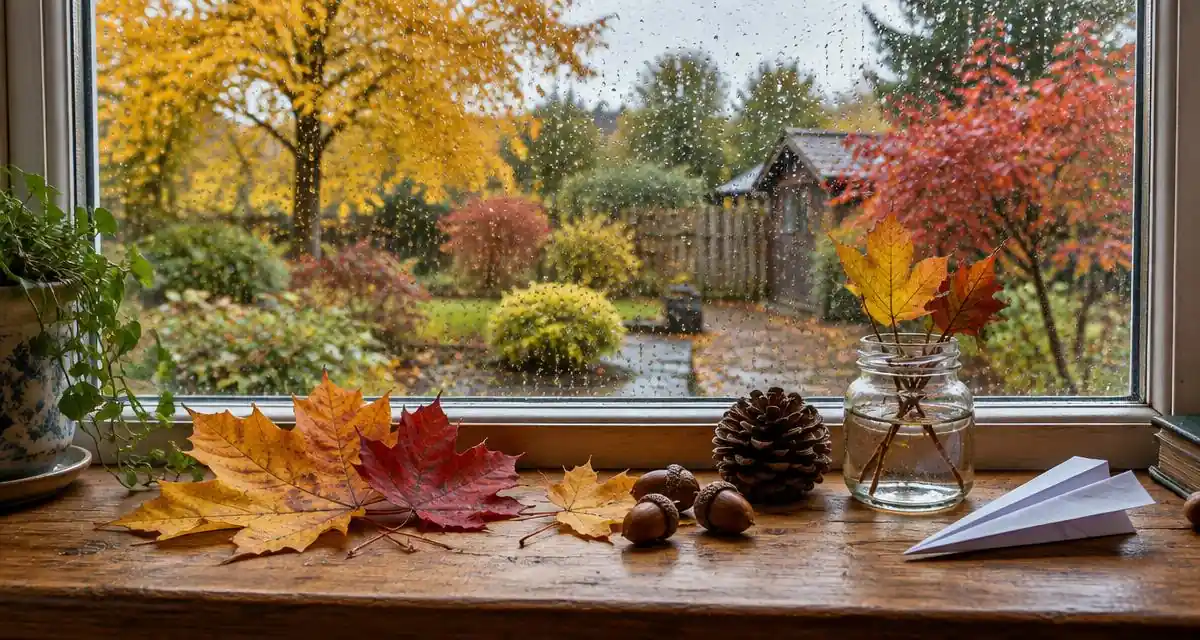
Ask a 10-year-old what they want to do on a wet Sunday in October, and you'll probably get a shrug, or a hopeful "just one more episode?".
As we saw in Part 1 of this guide, children move less and sit more once autumn sets in, especially at weekends. Yet the World Health Organization still recommends an average of 60 minutes of moderate-to-vigorous activity a day for them. The weather changes. The need doesn't.
What does change at 9 to 12 is how you get them moving. Tweens don't want to be entertained; they want to be in charge. So most of the ideas below put them in the driver's seat: they design the obstacle course, coach the family workout, direct the play, or run the experiment. You'll find ten activities for ages 9-10 and ten for ages 11-12, mixing indoor projects for the dark evenings with a few outdoor ideas for when the rain lets up.
Younger kids at home too? Part 1 covers ages 3 to 8.
Autumn activities for 9 and 10-year-olds
Nine and ten-year-olds usually love a challenge with a score attached, and they're ready for experiments that run like real science: prediction, method, results, conclusion.
1. Memory sprint
Where: Indoors (hallway) · Energy: High · Setup: under 5 min · Time: 10-15 min · You'll need: masking tape, paper, pencil, a phone timer
Setup: place five markers along the hallway, numbered 1 to 5 with masking tape, and mark a start line.
How it works: before each run, write a sequence of the five numbers (say, 3, 1, 5, 2, 4). Memorise it, turn the paper over, and sprint to touch each marker in that order. Record the time and whether the order was right. Do four runs with four different sequences. Score: time in seconds, plus 5 seconds for every wrong marker. Lowest score wins. It's harder than it sounds: holding a sequence in your head while running flat out takes real concentration.
Safety: no socks on smooth floors, clear the hallway first.
2. Jump circuit
Where: Indoors · Energy: High · Setup: 2 min · Time: 20-30 min · You'll need: masking tape, paper, pencil, a phone timer
How it works: your child designs five jumping stations, each with a clear rule written on a card. For example: two-footed jumps over a tape line (count in 30 seconds), star jumps (20 seconds), hopping on the left foot (20 seconds), squat jumps (30 seconds), side-to-side jumps over two parallel tape lines (30 seconds). Run the circuit with 30 seconds' rest between stations and record every count. Rest three minutes, then run it again. Which station improved? Add up the total and set a target for next time.
Safety: 2 metres of clear space around each station, no socks on smooth floors.
Too easy? Cut the rest between stations to 15 seconds or 10 seconds. Too hard? Three stations, longer rests.
3. Sock golf
Where: Indoors · Energy: High · Setup: 5-10 min · Time: 15-20 min · You'll need: 8 rolled-up socks, 9 targets (baskets, pots, bowls, boxes), masking tape, paper
Setup: turn the house into a nine-hole course. Each "hole" is a target in a different spot, numbered 1 to 9, with a tape cross on the floor as the tee.
How it works: write a scorecard with holes 1 to 9. From the tee, throw a sock at the target. If it misses, throw again from wherever it landed, and count the throws until it's in. Move on to the next hole. Add up the total (lower is better), then play the course again. Par is two or three throws per hole. A hole in one is, obviously, legendary.
Safety: soft rolled socks only, and nothing breakable near the targets.
Too easy? Add obstacles between tee and target (a cushion to throw over, a chair to go around). Too hard? Five holes instead of nine.
4. Land art challenge
Where: Outdoors · Energy: Calm · Setup: under 5 min · Time: 15-20 min · You'll need: whatever nature provides, a phone for photos
Autumn is the richest season for this: red, orange and brown leaves, pine cones, seed pods, conkers.
How it works: collect 20 natural items on a walk or in the garden. Lay them all out and look carefully at the colours, shapes and sizes. Then build a pattern, an animal or a mandala directly on the ground. Photograph it, gently take it apart, and try a second design that's completely different from the first.
Too easy? Only 10 items, and every one must touch another.
Too hard? Just sort the items into groups by colour or shape.
5. Treasure map
Where: Indoors · Energy: Calm · Setup: 2 min · Time: 20-30 min · You'll need: a large sheet of paper (A3, or two A4 sheets taped together), coloured pencils, a ruler
How it works: choose a subject: your home, your bedroom, or an imaginary land. Draw the outline from above (a bird's eye view) in pencil first. Add a scale ("1 square = 1 metre") and a key, with a symbol for each type of place. Mark at least five landmarks or paths, then add a title and a north arrow. Finally, hide a "treasure" somewhere in the house, mark it with an X, and challenge a family member to find it using only the map.
Too easy? Add three riddle clues that lead to the treasure.
Too hard? Draw just one room from above and label the furniture.
6. Density tower
Where: Indoors · Energy: Calm · Setup: 5-10 min · Time: 20-30 min · You'll need: kitchen scales, identical egg cups, a tall clear glass, water, oil, honey, milk, washing-up liquid, 6-8 small objects (a grape, a coin, a cork, an eraser, a paper clip, a small piece of wood or candle), paper and pencil
How it works:
- 1. Build the tower: weigh two tablespoons of each liquid and rank them from heaviest to lightest. Pour them into the tall glass in that order, heaviest first, and wait for the layers to form.
- 2. Predict: for each object, write down which layer you think it will stop at.
- 3. Test: drop the objects in one at a time and record where each one actually settles.
- 4. Analyse: which predictions were right? What decides where an object stops? (Its own density: it sinks until it reaches a liquid denser than itself.)
7. Static electricity lab
Where: Indoors · Energy: Calm · Setup: 2 min · Time: 15-20 min · You'll need: a balloon, a wool jumper or scarf, a ruler, tissue paper cut into 1 cm squares, paper and pencil
When the heating comes on, indoor air tends to get drier, and static gets stronger. (That crackle when you pull off a jumper? This is why.)
The question: does static get weaker the further away the balloon is?
How it works: rub the balloon on wool 20 times. Hold it 1 cm above the tissue squares and count how many jump up in three seconds. Rub again before every test and repeat at 2, 3, 5, 8 and 12 cm. Record the results in a table, then draw a line graph (distance along the bottom, pieces lifted up the side). What shape is the graph? At what distance did the effect disappear? Did it fade gradually or suddenly?
The science: the electrostatic force weakens very quickly as distance increases, which is why the graph drops off so steeply.
Too easy? Pin down the exact distance where the force hits zero. Too hard? Test three distances and skip the graph.
8. Cloud journal
Where: Outdoors · Energy: Calm · Setup: 1 min · Time: 20 min · You'll need: paper and pencil, a coat, somewhere to sit or lie down
Autumn skies are some of the most dramatic of the year. A doorstep or a garden bench is enough.
How it works: ten minutes of silent watching, no phone. For the first five minutes, just watch. For the next five, notice details: the texture of one cloud, the speed of a bird against a plane, how the light shifts. Then ten minutes of writing: a journal entry for someone who can't see the sky and has to picture it from your words. It needs at least two precise cloud descriptions (not "fluffy", more like "a dense, flat-bottomed shelf of grey-white cloud with ragged edges"), one observation about movement, one about light or colour, and how the sky made you feel. Aim for 100 to 150 words.
Mindfulness note: every time you noticed your mind drifting and brought it back, that was the practice. How many times did it happen?
Too easy? Sketch the sky in pencil or watercolour, with the description underneath. Too hard? Write a haiku, or three sentences.
9. Logic grid puzzle
Where: Anywhere · Energy: Calm · Setup: 2 min · Time: 10-15 min · You'll need: paper and pencil
The puzzle: Amara, Blake, Callum, Demi and Ethan each do one sport: running, swimming, cycling, basketball or judo. Who does what?
Useful categories: basketball is the only team sport. Judo is a combat sport. Cycling and basketball need equipment. Swimming is a water sport.
- 1. Amara's sport is a water sport.
- 2. Blake does not do a solo sport.
- 3. Callum's sport has wheels.
- 4. Demi does a combat sport.
- 5. Ethan's sport is outdoors and needs no equipment.
- 6. Blake does not play with a ball.
How to solve it: read every clue before marking anything. Draw a grid (people as rows, sports as columns). Start with the definite clues, then use the categories to rule out whole groups. Sometimes one clue isn't enough on its own, but two together crack a box. Finally, check every clue against your answers.
(Answer, for grown-ups: Amara swims, Blake plays basketball, Callum cycles, Demi does judo, Ethan runs.)
Too easy? Invent a five-person puzzle for someone else.
10. Clay scene
Where: Indoors · Energy: Calm · Setup: 5-10 min · Time: 30+ min, plus 2 days' drying · You'll need: air-dry clay, a mat, a toothpick, acrylic paint, a brush, a 15 × 15 cm square of cardboard
A proper multi-day project for a rainy week: sculpt on Tuesday, paint on Thursday.
How it works: plan the scene on paper first (who's in it, where, what's happening). Build it on the cardboard base with at least two characters and one piece of setting (a tree, a rock, a table, a vehicle). Score and slip every join so nothing falls off. Leave it to air-dry for 48 hours (bigger pieces take longer), then paint the whole scene in thin coats, letting each dry. Finally, present it and tell its story.
Too hard? One character and one prop.
Autumn activities for 11 and 12-year-olds
At 11 and 12, the best activities are the ones that give real responsibility: planning, leading, directing, testing. The more it feels like a project they own, the less it feels like something a parent came up with.
11. Family fitness coach
Where: Indoors · Energy: High · Setup: 2 min · Time: 20-30 min, plus 15-20 min of planning · You'll need: paper, pencil, a phone timer · Best with: the whole family (yes, you're in the workout)
How it works: your child plans a 15-minute session everyone can join:
- Warm-up (2 min): two gentle exercises
- Main circuit (10 min): five or six exercises with clear reps or timings
- Cool-down (3 min): slow stretches, noting which muscles each one targets
For each exercise, they write coaching cues ("keep your back straight in the plank, don't let your hips drop") and an easier version for younger kids or less fit adults.
Then they gather the family, explain the plan in a minute, demonstrate each exercise and lead it, encouraging and correcting along the way.
Afterwards: what did everyone like, and what was too hard or too easy?
Safety: check the space first, and demonstrate every exercise before the family tries it, use coading video if needed.
Too easy? A 20-minute session with eight exercises. Too hard? Lead the warm-up and main circuit only.
12. Design-your-own ninja course
Where: Indoors · Energy: High · Setup: 10 min · Time: 20-30 min · You'll need: cushions, chairs, blankets, masking tape, soft toys, pillows
How it works:
- 1. Design: on paper, plan eight obstacles, each with a name, what to do, where it goes, and how you fail it (touch the floor, 5-second penalty).
- 2. Build: set up the course with whatever's available.
- 3. Rulebook: one page with all eight rules, the penalty system and how to calculate the final score.
- 4. Test: run it twice. Is everything fair? Is anything dangerous? Adjust.
- 5. Host: family members take turns while your child referees, times each run, calculates scores and keeps a leaderboard.
Safety checklist before opening: no obstacle higher than the sofa seat, no hard landing zones, blankets and cushions stable before each run.
Too easy? Add a timed bonus challenge between two obstacles. Too hard? Five obstacles only.
13. Choreograph the family routine
This one will make you work too and have fun time together.
Where: Indoors · Energy: High · Setup: 2 min · Time: 20-30 min, plus teaching · You'll need: music, paper and pencil, a phone for filming (optional)
How it works: choose a song together, or let your child pick. They listen three times and map its structure (intro, verse, chorus, bridge, outro), then design the moves: the chorus gets the most energetic one, the verses something simpler. The routine is written down one move per line with rough timings, and it must last 90 to 120 seconds, use at least seven different moves, include a formation change (line, then circle, then pairs) and start and end on a pose.
After practising alone three times, your child teaches it to the family move by move, then everyone performs it together.
Safety: make sure the room fits everyone before the teaching starts.
Too easy? Add synchronised arm movements on specific lyrics. Too hard? A 60-second routine.
14. Seasonal sensory walk journal
Where: Outdoors · Energy: Calm · Setup: 1 min · Time: 30 min per session (it can be shorter), 4 sessions over 2 weeks · You'll need: a dedicated notebook, pencil, a sketchbook (optional)
Autumn is the ideal time for this, because the same place changes so much from one week to the next.
How it works: same place (garden, park or regular route), four different days across two weeks. Each session: 15 minutes of walking in silence, no phone, no music, then 15 minutes of writing:
- Date, time, weather
- Attention rating out of 10: how present were you?
- Three precise sensory observations
- One thing that's different from last time (light, sound, season, your own mood)
- Roughly how often your mind wandered, and where to
- How you felt coming back, in three words
After the four sessions, a one-page analysis: did attention ratings change? What did the mind keep wandering to? What changed outside, and what changed inside?
Too easy? Add a sketch of the same view from the same spot each time.
Too much? Two sessions with shorter notes.
15. Bridge builder
Where: Indoors · Energy: Calm · Setup: 2 min · Time: 20-30 min · You'll need: paper, card, lolly sticks, string, tape, straws, foil (whatever you have), coins as weights, a ruler
How it works: the full engineering process.
- 1. Specification (before touching any material): span at least 30 cm, hold at least 200 g (roughly 40 large coinsor use soft toys), and a list of exactly which materials will be used.
- 2. Design: a side-view sketch, each part labelled with its job, and a guess at where the forces will be greatest.
- 3. Build: follow the design, noting any changes and why.
- 4. Test: load it up to 200 g, or until it fails. Record the maximum load and sketch the failure point.
- 5. Report: did it meet the spec? What worked, what didn't, what changes in version 2? Which real-world bridge type (arch, suspension, beam, truss) uses a similar idea?
Too easy? Give each material a "cost" and set a budget. Too hard? Skip the written brief: build, test, and talk it through.
16. Radio drama series
Where: Indoors · Energy: Calm · Setup: under 5 min · Time: 50+ min · You'll need: paper, pencil, a phone for recording, household objects for sound effects · Best with: 2 to 5 kids
Long, dark evenings were made for audio thrillers.
How it works:
- 1. Concept (10 min): invent a series that could run for three to five episodes: title, genre (comedy, thriller, adventure, mystery), main characters and their voices, the big mystery running through the whole series, and a cliffhanger for episode one.
- 2. Script (20 min): episode one in full, with a title sequence (theme tune plus narrator), at least one scene told entirely through sound, a twist halfway through and a cliffhanger final line.
- 3. Record (20 min): a director gives voice notes ("more frightened, you don't know who's in the house"), cues the sound effects and calls for retakes.
- 4. Review: listen back and rate story, voices and sound design out of 5 each. Then outline episode two.
Too easy? Record episode two in the same session. Too hard? Perform episode one live in one take.
17. Friendship bracelets
Where: Anywhere · Energy: Calm · Setup: 2 min · Time: 20-30 min · You'll need: embroidery thread or wool in 2-4 colours, scissors, tape, large beads (optional)
How it works: choose two or three colours and cut about 50 cm of each. Knot them together at one end and tape the knot to the edge of a table to keep your hands free. Then either braid (split the threads into three groups: left over middle, right over middle, repeat) or knot (take the leftmost thread and tie a forward knot around each of the others, working left to right). Keep going until the bracelet is about 15 cm long. Measure it against your wrist, add 4 cm for tying, knot it off and trim the ends.
Too easy? Try a four-strand braid or a chevron pattern.
Too hard? A simple three-strand wool braid, no knots.
18. Outdoor scavenger race
Where: Outdoors (garden, park or a walk around the block) · Energy: Medium · Setup: 5 min · Time: 10-15 min · You'll need: a written list, a pencil, a timer
Setup: write a list of 10 to 15 things to find, with clues that make them think: something that starts with B, something older than you, something made of wood, something that crunches underfoot, three leaves of different colours, something a bird could use for its nest.
How it works: read the whole list first, set a 5-minute timer, then go. Tick off each item as you find it (touch it or photograph it, no need to bring anything home). When the timer rings, score out of the total. Then swap roles: your child writes a new, harder list for the next player, whether that's a sibling, a friend or you.
Too easy? Items must be found in alphabetical order.
Too hard? Five items and 10 minutes.
19. Logic grid puzzle, expert level
Where: Anywhere · Energy: Calm · Setup: 2 min · Time: 15-20 min · You'll need: paper and pencil
The puzzle: five chefs (A, B, C, D and E) each cook one cuisine (Italian, Thai, Japanese, Moroccan, Brazilian) using one method (grilling, steaming, frying, baking, raw). Match each chef to both.
- 1. Chef A specialises in pasta dishes.
- 2. Chef B never uses heat: everything is served raw.
- 3. Chef C's dishes are always light and steamed.
- 4. Moroccan cuisine uses the oven: tagines are baked.
- 5. Chef D is from South America.
- 6. Japanese cuisine at this restaurant uses no heat at all.
- 7. Chef E is not from Asia or Europe.
- 8. The South American chef grills over an open fire.
How to solve it: draw two grids, one for cuisines and one for methods. Read all eight clues first, fill in the definite ones in both grids, then cross-reference: what you learn in one grid unlocks the other. Write the five full answers and check every clue.
(Answer, for grown-ups: A Italian and frying, B Japanese and raw, C Thai and steaming, D Brazilian and grilling, E Moroccan and baking.)
Too easy? Add a third category and write three new clues. Too hard? Solve the cuisine grid on its own first.
20. Pillow capture the flag
Where: Indoors · Energy: High · Setup: 5 min · Time: 15-20 min · You'll need: a pillow per player, masking tape, 2 rolled-up socks · Best with: 2 to 4 players
Setup: clear the full length of the room and split it in two with a tape line down the middle. Put a rolled-up sock (the "flag") at the far end of each half.
How it works: each player defends their half. To score, cross the line, grab the other side's flag and bring it back without being tapped on the shoulder with a pillow. Tapped in enemy territory? Go back to your own half and try again; the flag stays where it is. First to three captures wins. No timer, no rulebook, just play.
Safety: no hits to the head, a soft floor if possible, and no hard furniture in either half.
Too easy? Players have to hop on one foot in the other half.
Too hard? Attackers get three seconds of safety after crossing the line.
Making the most of the dark months
There's no autumn checklist to complete, and no prize for trying all twenty ideas before Christmas. Some evenings, a 10-minute jump circuit before dinner and a logic puzzle afterwards is plenty. Other weeks, a longer project quietly gives a restless 11-year-old something to look forward to. Both are wins.
At this age, the best gift is often not the idea itself but the trust that comes with it. Let them choose, plan and lead, and give them a little more room than feels comfortable. A tween who designed the ninja course will happily run it ten times. One who was simply told to do an obstacle course might be back on the sofa within minutes. (We've all been there, and that's okay too.)
And on the evenings when you're tired, busy or simply out of ideas, Belxi is here to help. Tell it your child's age and interests, plus what you think they need right now, and in 30 seconds it suggests a screen-free activity that fits the moment.
Younger children at home? Part 1: autumn activities for ages 3 to 8.